
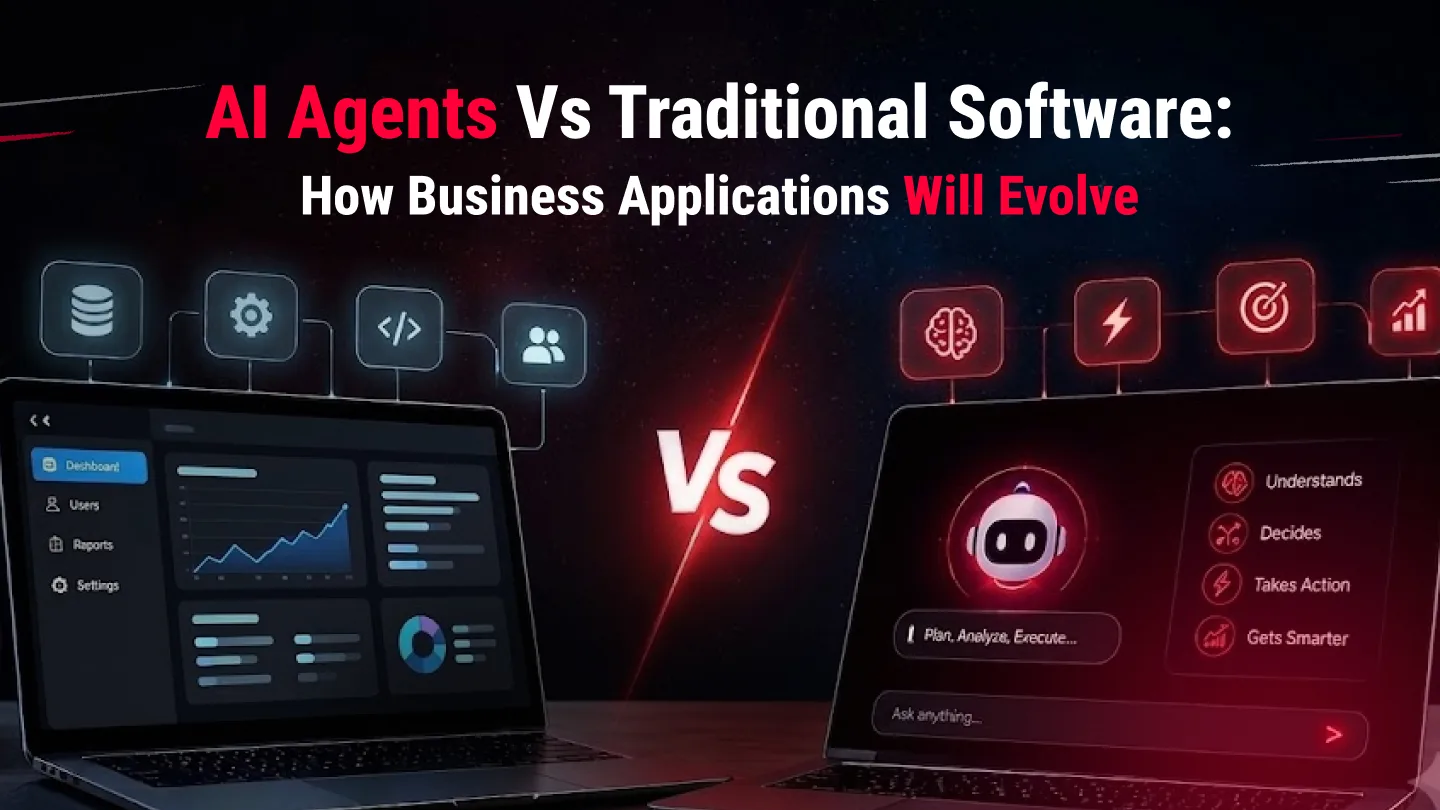
Traditional software runs fixed steps you operate — you click, it executes what a developer coded. An AI agent is given a goal and works out the steps itself: it reasons, calls tools and other apps, checks the result, and adjusts. As agents mature, business applications shift from menus and forms you navigate to outcomes you delegate. Your CRM, ERP, and help desk don't vanish — they become tools an agent operates on your behalf. The interface moves from "click through features" to "state what you want." Businesses with clean data, connected systems, and clear processes will adopt this shift fastest.
Open almost any business tool today — a CRM, an accounting package, a project tracker — and the experience is fundamentally the same as it was in 2005. There are menus. There are forms. There are buttons. You, the human, hold the plan in your head and drive the software one click at a time. The software is powerful, but passive: it does exactly what you tell it, no more, no less.
AI agents invert that relationship. Instead of you operating the software step by step, you hand the software an objective and let it operate itself. That single change — from executing instructions to pursuing goals — is the biggest shift in how business applications work since the move to the cloud. Here's what actually separates the two, and where it leads.
1. Fixed instructions vs. goal-seeking
Traditional software is deterministic. A developer decides, in advance, every path the program can take: if the user clicks this, do that. It's reliable and predictable precisely because it never deviates from its script. The flip side is that it can only do what was explicitly built, and a human has to supply the intelligence — deciding what to do, in what order, and why.
An AI agent is goal-seeking. You give it an outcome — "reconcile last month's invoices," "draft replies to every unanswered support ticket," "find and qualify leads that match our best customers" — and it plans its own steps. It can handle situations no one scripted, because it reasons about the goal instead of following a fixed decision tree. The intelligence moves from the human into the software.
2. Something you operate vs. something you delegate to
The clearest way to feel the difference: traditional software is a tool, an agent is closer to a worker. You operate a tool; you delegate to a worker. With a spreadsheet you do the thinking and it does the calculating. With an agent, you describe the result you want and it does both — the thinking and the doing — then comes back with the outcome or a question.
This is why agentic applications feel so different to use. The skill you need shifts from "knowing where every button is" to "clearly describing what good looks like." That's a far lower barrier for most employees, which is exactly why agent-driven software spreads quickly once it works.
3. Agents use your existing software as tools
A common fear is that agents will replace all the software a business already paid for. In practice, the opposite happens: agents use that software. Modern agents work by calling tools — APIs, databases, apps — the same way a person clicks through them, only faster and without fatigue. Your CRM becomes a tool the agent updates. Your email becomes a tool it sends from. Your ERP becomes a tool it queries.
That means the systems of record that run your business mostly stay. What changes is the layer on top: instead of ten people navigating ten interfaces, agents operate those interfaces while people supervise. Software vendors are racing to expose their features as clean, well-documented tools precisely because being "agent-callable" is becoming as important as being user-friendly.
4. Rigid workflows vs. adaptive ones
Traditional automation — the "if this, then that" kind — breaks the moment reality doesn't match the script. An unexpected email format, a missing field, an edge case no one anticipated, and the workflow stalls or errors out. It automates the happy path and dumps everything else on a human.
Agents handle messiness far better because they reason rather than match patterns rigidly. Faced with something unusual, an agent can interpret it, decide on a sensible action, or escalate with context instead of simply failing. This is what lets agents take on the long tail of real-world work that rule-based automation never could — the exceptions that actually eat up most of a team's time.
The difference, in one table
| Dimension | Traditional software | AI agents |
|---|---|---|
| You give it | Instructions (clicks, steps) | A goal (an outcome) |
| Who plans the steps | The human | The agent |
| Handles new situations | Only if pre-coded | Reasons about them |
| Interaction | Menus & forms | Natural-language intent |
| Relationship | A tool you operate | A worker you delegate to |
| Other software | Separate apps you switch between | Tools the agent calls |
What this means for business applications
As agents mature, expect business apps to change in a few concrete ways:
- Interfaces get a conversational front door. Alongside the usual dashboards, you'll increasingly just ask for what you need and let an agent fetch, update, or act.
- Features become tools. Vendors will design functions to be called by agents, not only clicked by people — clean APIs and permissions become a competitive feature.
- Work moves from doing to reviewing. People spend less time executing repetitive steps and more time setting goals, checking agent output, and handling exceptions.
- Integration matters more than any single app. An agent's value comes from reaching across your systems, so connected, clean data becomes the real advantage.
How to prepare now
You don't need to rip anything out. Move toward agentic software by strengthening the foundations agents depend on:
- Clean and connect your data. Agents are only as good as the information they can reach — siloed, messy data limits them immediately.
- Document your key processes. Clear, well-defined workflows are the easiest to delegate; vague ones are hard for humans and agents alike.
- Expose functions through APIs. The more of your systems an agent can safely act on, the more it can actually do.
- Start small, with guardrails. Pick a repetitive, low-risk task, add permissions, logging, and human approval, then expand autonomy as trust grows.
- Traditional software runs fixed steps you operate; AI agents pursue goals you delegate.
- Agents don't replace your existing software — they use it as tools and operate it for you.
- The interface shifts from menus and forms to stating what you want.
- Agents handle exceptions and messy real-world work that rigid automation can't.
- Clean data, clear processes, and connected systems decide who adopts agents fastest.
Dezvo builds AI into the software businesses actually run on — from agentic assistants and workflow automation to custom applications designed to be operated by both people and AI. Explore our AI integration, web application development, and website development services, or read our primer on Gen AI, LangChain & LangGraph. Tell us the outcome you want to automate and we'll help you build toward it.