
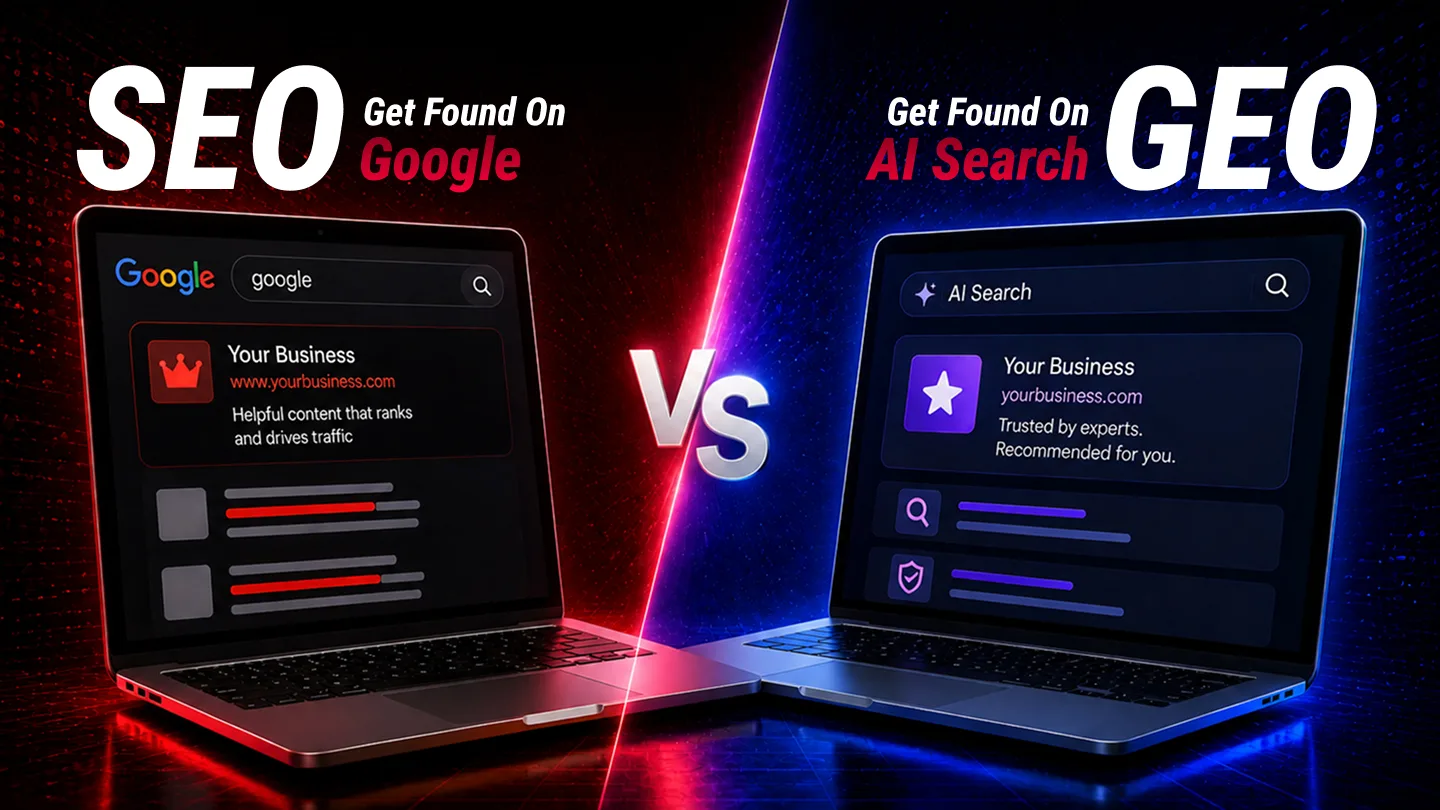
SEO gets your pages to rank in traditional search so people click to your site. GEO (generative engine optimization) gets your business cited and recommended inside AI answers from ChatGPT, Perplexity, Google AI Overviews, and Copilot. They share one foundation — clear, credible, well-structured content — but GEO adds an emphasis on being quotable, factual, and machine-readable. GEO isn't replacing SEO; it's a new layer on top. To get found in 2026 you need both: rank the page, and be the source the AI trusts.
For twenty years, “getting found online” meant one thing: ranking on Google. You optimized pages, earned links, and climbed the list of ten blue links. That game still matters — but it's no longer the whole board.
A growing share of searches now end inside an AI answer. Someone asks ChatGPT for “the best web design agency for B2B SaaS,” or Google shows an AI Overview that summarizes and cites a handful of sources — and the user never scrolls to the traditional results at all. Being invisible in those answers means being invisible to a large and rising slice of your market. That's the gap GEO fills.
What SEO does
Search engine optimization is the practice of making your pages rank in search engines. The goal is a click: you want to appear as high as possible in the results so the searcher visits your site. It rests on three pillars:
- Technical: a fast, crawlable, mobile-friendly, well-structured site engines can index without friction.
- Content: pages that match what people search for and answer it better than the competition.
- Authority: links and signals from other reputable sites that tell engines you can be trusted.
SEO is mature, measurable, and still enormously valuable. Most businesses get more traffic from organic search than any other channel — and, importantly, the pages that rank well are often the same ones AI engines quote.
What GEO does
Generative engine optimization is the practice of getting your business surfaced inside AI-generated answers. The goal isn't only a click — it's a citation, mention, or recommendation. When someone asks an AI a question in your space, you want to be the source it references and the name it recommends.
GEO works differently because AI engines don't return a ranked list — they synthesize an answer from sources they can crawl, understand, and trust. To be one of those sources, your content has to be:
- Quotable: clear statements, concise definitions, and direct answers a model can lift cleanly.
- Structured: headings, lists, tables, FAQs, and schema that make meaning explicit to machines.
- Credible: factual, well-sourced, and backed by a clear author and organization identity.
- Cited elsewhere: mentioned and referenced across the wider web, not just on your own domain.
Where they overlap
Here's the good news: SEO and GEO share the same foundation. Both reward clear, helpful, credible, well-structured content on a technically sound site. A page that genuinely answers a question, loads fast, and earns trust tends to do well in both a Google ranking and an AI answer. You're not building two separate machines — you're strengthening one, then tuning it for two audiences: humans clicking links, and models extracting answers.
Where they differ
| Dimension | SEO | GEO |
|---|---|---|
| Goal | Rank the page, earn the click | Be cited & recommended in the answer |
| Surface | Search results (links) | AI answers & overviews |
| Optimizes for | Keywords, relevance, authority | Quotability, structure, factual trust |
| Winner's reward | Traffic to your site | Visibility & recommendation, often pre-click |
| Measurement | Rankings, clicks, impressions | Citations, mentions, AI referral traffic |
| Maturity | Established, well-tooled | Emerging, evolving fast |
How to win on both
You don't run two campaigns. You build a strong content and technical foundation, then layer GEO-specific habits on top. A practical playbook:
1. Nail the fundamentals first
Fast, crawlable, mobile-friendly pages with clear information architecture. If engines and AI crawlers can't access and parse your site easily, nothing else works. This is shared ground for SEO and GEO.
2. Write answers, not just pages
Structure content around the real questions people ask. Lead each section with a direct, quotable answer, then support it. This helps you rank for long-tail queries and gives AI engines clean passages to cite.
3. Make meaning machine-readable
Use descriptive headings, lists, tables, and FAQ sections. Add schema markup — Article, FAQ, Organization, Product — so both search engines and AI understand what your content means and who stands behind it.
4. Build authority on and off your site
Earn mentions, citations, and links from reputable sources. AI engines weigh how often and how consistently you're referenced across the web. Being talked about elsewhere is now a ranking and a citation signal.
5. Establish a clear identity
Show real authors, a defined organization, and consistent facts about your business across the web. Generative engines favor sources with a trustworthy, coherent identity they can attribute an answer to.
How to measure it
SEO measurement is well understood: rankings, impressions, clicks, organic traffic. GEO is newer, but you can track it:
- Test prompts across ChatGPT, Perplexity, Google AI Overviews, and Copilot for your key queries — do you appear?
- Watch AI referral traffic in analytics as these platforms send more visitors.
- Track brand mentions and citations across the web over time.
- Note branded and direct traffic, which tends to rise as AI visibility grows.
- SEO wins the ranking and the click; GEO wins the citation inside AI answers.
- GEO isn't replacing SEO — it's a new layer built on the same foundation.
- Clear, credible, well-structured content is what both reward.
- Add GEO habits: quotable answers, schema, machine-readable structure, and off-site authority.
- Measure both — rankings and clicks for SEO, citations and AI referrals for GEO.
Dezvo helps businesses get found across search and AI — from technical SEO to generative AI strategy and websites built to be ranked and quoted. Tell us where you want to show up and we'll build the plan to get you there.