
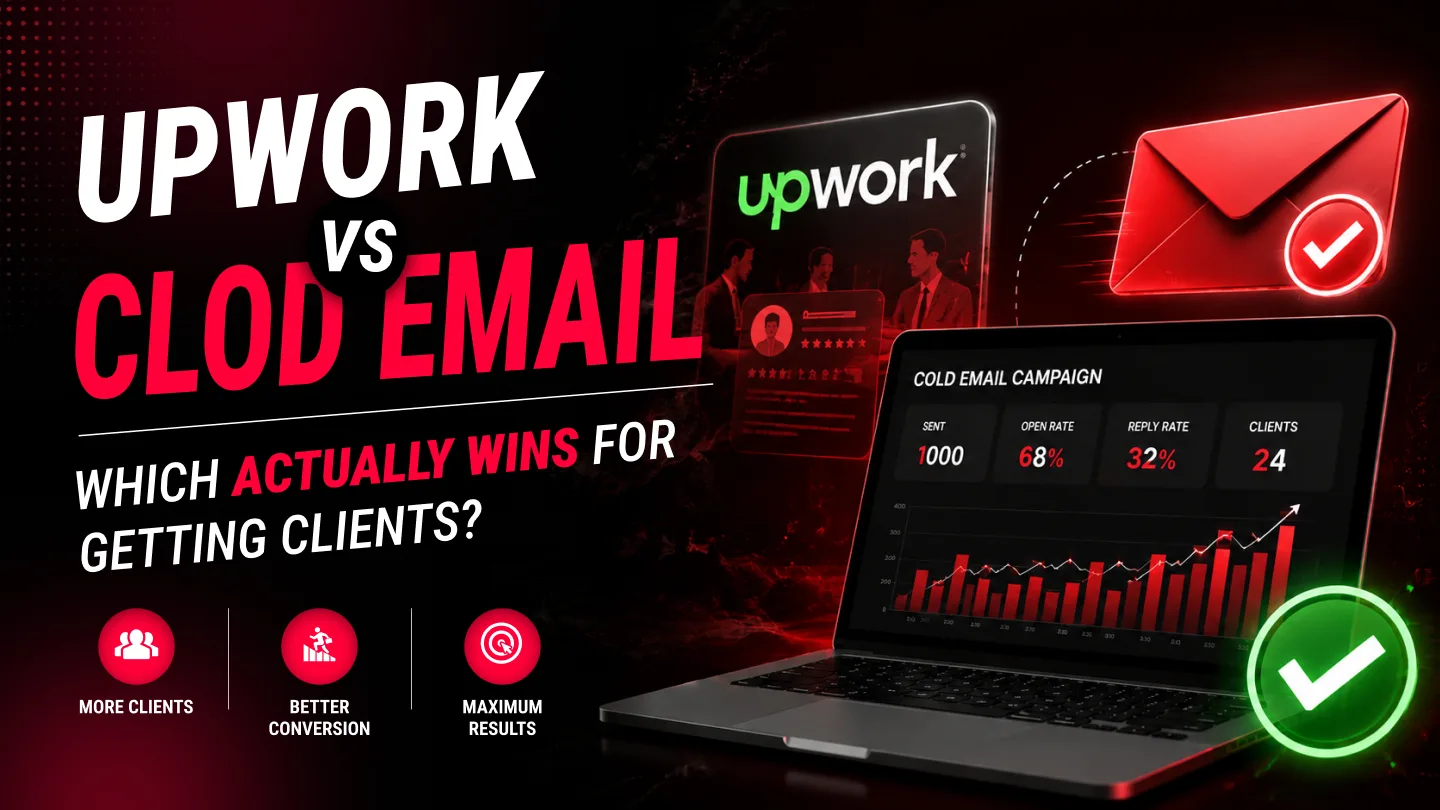
Upwork gives you fast access to buyers who are already looking, with almost no setup — but you compete on price and pay platform fees. Cold email wins you higher-value, higher-margin clients with full control over who you target — but it takes weeks to warm up and rewards skill in targeting and copy. If you need cash flow now, start on Upwork. If you want a predictable, premium pipeline, build cold email. Serious agencies run both: Upwork for proof, cold email for growth.
“How do I get clients?” is the question every freelancer and agency keeps answering forever. In 2026 two channels dominate the conversation: bidding on marketplaces like Upwork, and running cold email outreach to companies you actually want to work with. They both fill a pipeline — but they are not interchangeable. One is demand you tap into; the other is demand you create.
This isn't a “marketplaces are dead” hot take or a “cold email is spam” dismissal. Both work, right now, for different people at different stages. Here's how they really compare — and how to decide.
Upwork: demand that already exists
Upwork's core advantage is simple: the buyers are already there, wallet out, describing a job they want done. You don't create demand — you show up where it's pooled and compete for it. That makes it the fastest way to land a first paying client with zero audience, no website traffic, and no outreach infrastructure.
Where it wins:
- Speed to first client. A well-written proposal can win work in days, not months. There is no warm-up, no list building, no domain setup.
- Built-in trust. Escrow, reviews, and dispute resolution lower the buyer's risk of hiring a stranger — which means they hire strangers more readily.
- Proof that compounds. Early reviews and a Job Success Score become social proof you can use everywhere, including in cold outreach later.
Where it hurts:
- Price competition. You're one of dozens bidding on the same job, often against much cheaper providers. Margins get squeezed unless you can clearly differentiate.
- Platform fees and Connects. Upwork takes a service fee on what you earn and charges Connects to submit proposals, so a slice of every dollar — and every bid — belongs to the platform.
- You don't own the relationship. The client is Upwork's contact first. Rules, ranking, and fee changes are outside your control, and taking clients off-platform is restricted.
Cold email: demand you create
Cold email flips the model. Instead of waiting where buyers gather, you go straight to the exact companies you want as clients and start a conversation. Nobody posted a job — you created the opportunity. That's harder, slower, and far more powerful when it works.
Where it wins:
- You choose the client. Target by industry, size, tech stack, funding, or location. You're not limited to who happens to be posting today — you can pursue the accounts worth real money.
- Higher margins. No marketplace fee and no race-to-the-bottom bidding. Direct deals mean you set the price against value, not against the cheapest bidder.
- You own the pipeline. Your list, your inboxes, your relationships. No algorithm can bury you overnight, and clients stay yours.
Where it hurts:
- Slow to start. Domains need warming, lists need building, and copy needs iterating. Expect four to eight weeks before booked calls become consistent.
- Skill-dependent. Bad targeting or generic copy gets ignored or marked as spam. Results live and die on relevance and a sharp, specific offer.
- Infrastructure and upkeep. Sending domains, inboxes, a platform, and lead data cost money and attention. Deliverability is a discipline, not a set-and-forget.
Head-to-head: the honest scorecard
| Factor | Upwork | Cold email |
|---|---|---|
| Time to first client | Days | 4–8 weeks |
| Setup effort | Very low | Moderate to high |
| Cost model | % fee on earnings + Connects | Mostly fixed tooling cost |
| Lead quality & deal size | Mixed, often price-driven | You choose — can be premium |
| Competition | High, on every job | Low, if targeting is sharp |
| Who owns the client | The platform | You |
| Scales by | More proposals, better rank | More volume + better copy |
Which one is right for you?
Match the channel to your stage and goals, not to what a guru sells:
- Just starting, need cash flow? Upwork. It converts effort into income fastest and hands you the reviews you'll need later.
- Have proof and want bigger clients? Cold email. Use your case studies to reach accounts that would never post a public job.
- Running an agency? Cold email should be your growth engine — predictable, high-margin, and yours — but Upwork can still fill gaps and surface unexpected wins.
- Highly specialised or premium-priced? Cold email almost always wins. Marketplaces reward volume and price; direct outreach rewards positioning.
The strongest play: use both
The teams with the most predictable pipelines rarely pick a side. A practical sequence looks like this:
- Bank early wins on Upwork. Land a handful of solid projects, collect reviews, and turn them into sharp, results-focused case studies.
- Package the proof. “We helped a SaaS company cut onboarding drop-off by 30%” is the raw material for outreach that gets replies.
- Build a focused cold email system. Tight targeting, a specific offer, and genuine relevance — sent to companies that fit your best work.
- Shift the weight over time. As cold email produces higher-margin direct clients, it becomes the engine; the marketplace becomes a supplement.
Both channels also share one dependency: whatever you point traffic to has to convert. A weak website, a vague offer, or a slow reply leaks clients no matter where they come from. That's usually the cheapest fix of all — and the one people skip.
- Upwork = fast access to existing demand, low setup, but price competition and platform fees.
- Cold email = you choose premium clients at higher margins and own the relationship, but it takes weeks to warm up and rewards skill.
- Beginners and cash-flow needs favour Upwork; agencies and specialists favour cold email.
- The winning move is a sequence: earn proof on Upwork, then scale with cold email — and make sure whatever you send traffic to actually converts.
Dezvo helps service businesses turn attention into booked clients — from a high-converting website to email systems and LinkedIn outreach that fill the pipeline. Tell us how you get clients today and we'll help you make it predictable.