
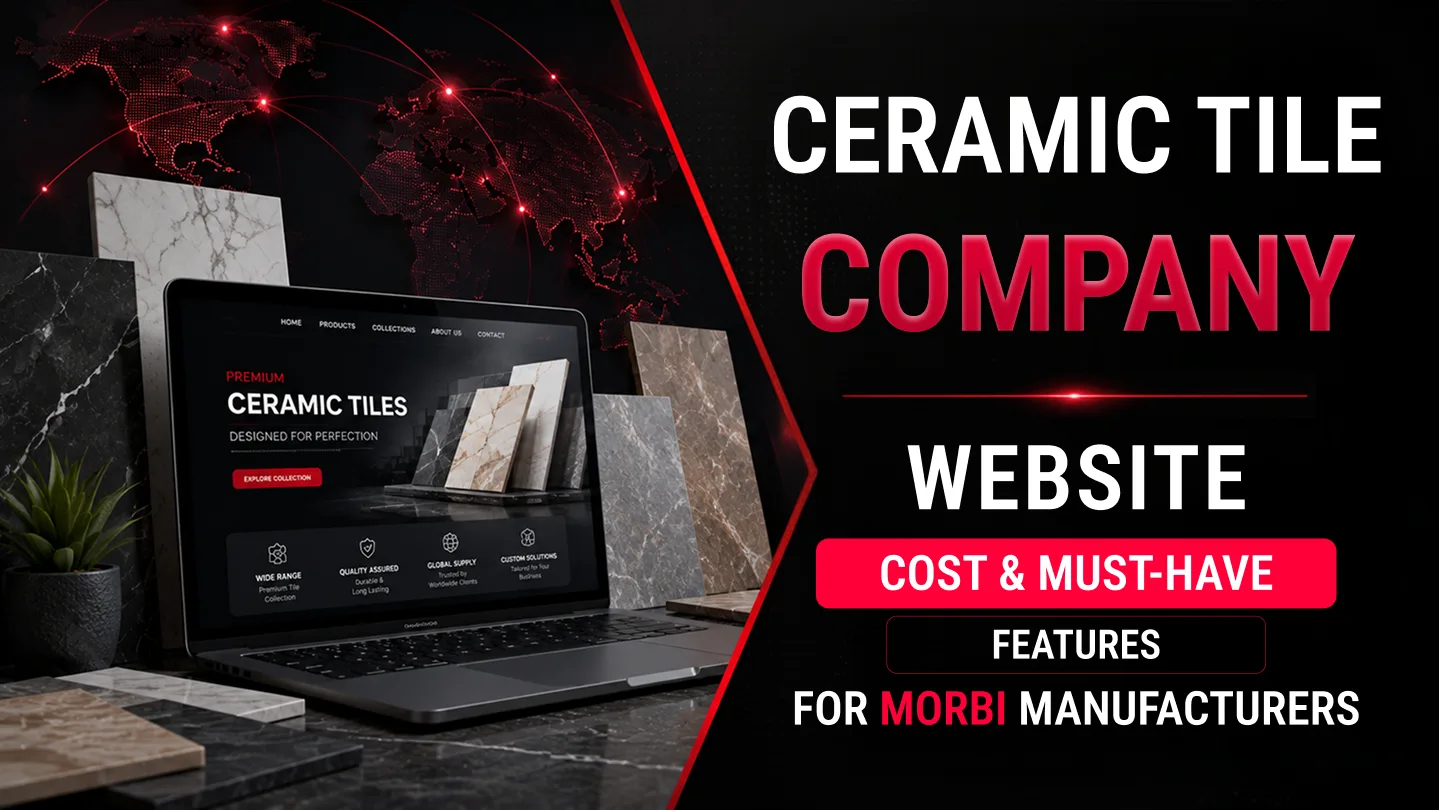
A ceramic tile company website in India costs between ₹40,000 and ₹3 lakh+ in 2026, depending on tier: a brochure site (₹40k–80k) establishes credibility, an export-ready catalogue website (₹1–2.5L) generates buyer inquiries with filterable products and spec sheets, and a B2B platform (₹3L+) adds dealer logins and ERP sync. For most Morbi manufacturers, the catalogue tier is the right investment — it's the version international buyers expect to see before placing container orders.
Every week, importers and project buyers shortlist Morbi tile manufacturers from Google, marketplaces, and trade-fair follow-ups. And every week, manufacturers with excellent products lose those buyers at the same step: the website. A blurry logo, a “gallery” of unlabelled tile photos, and a contact form nobody answers — that's what a five-figure-dollar buyer sees, thirty seconds before choosing a competitor.
This guide breaks down what a ceramic tile company website should actually include in 2026, what each tier costs, and the mistakes that quietly kill inquiries. It pairs with our guide on getting international buyers for Morbi ceramic tiles — the website is the foundation that playbook stands on.
Why does a tile manufacturer need a website when orders come through agents?
Because every serious buyer verifies you online before money moves — including buyers your agent brings. Morbi ships to 130+ countries; the units converting that reach into their own brand equity share three digital habits: they're findable on Google, their product data is self-serve, and their inquiry response is measured in minutes. The website is where all three live.
- Credibility: a container order is an act of trust in a factory the buyer has likely never visited. Certifications, factory videos, and export references on your own domain de-risk that decision.
- Self-serve specs: buyers compare sizes, finishes, water absorption, and packing maths across suppliers. If your data needs a phone call, you're the supplier they skip.
- Owned channel: marketplaces and agents rent you demand. SEO on your own site compounds — a page ranking for “600x1200 GVT manufacturer India” produces inquiries for years.
What does a ceramic tile company website cost in 2026?
| Tier | Typical cost (INR) | What you get | Right for |
|---|---|---|---|
| Brochure site | ₹40k–80k | 5–8 pages: company, product ranges, certifications, contact. Mobile-fast, basic SEO. | New units needing credibility for trade-fair & marketplace follow-ups. |
| Catalogue website | ₹1–2.5 lakh | Filterable catalogue (size/finish/series), spec-sheet downloads, packing & MOQ data, WhatsApp inquiries, schema markup, export pages. | Manufacturers & exporters actively generating buyer inquiries. The sweet spot for most Morbi units. |
| B2B platform | ₹3 lakh+ | Everything above + dealer/distributor logins, tiered pricing, order requests, Tally/SAP sync, multi-language, multi-currency. | Established brands running dealer networks and large export books. |
Ongoing costs are modest: hosting and domain run a few thousand rupees a year on modern static or lightweight stacks; the real recurring investment is content — new series pages, catalogue updates, and SEO that keeps the site earning.
The 9 features international buyers expect
1. Filterable digital product catalogue
Buyers think in constraints — 600×1200, matt, PGVT, 9mm. A catalogue filterable by size, finish, series, and application answers in seconds what a PDF makes them dig for. Each product needs its own URL so Google (and AI assistants) can index and cite it.
2. Technical spec sheets, downloadable
Water absorption, breaking strength, PEI rating, slip resistance, shade variation. Downloadable PDFs per series are what procurement teams forward internally — make them easy to grab, branded, and current.
3. Packing & container data
Pieces per box, weight per box, boxes per pallet, quantities per 20ft/40ft container, MOQ. Exporters who publish this save two email round-trips on every inquiry — and signal they've done this before.
4. Certifications, displayed properly
CE for Europe, SASO for Saudi Arabia, BIS/ISI for India, ISO for everyone. Scanned certificates with numbers beat logo strips — buyers actually check.
5. WhatsApp-first inquiry flow
The global tile trade runs on WhatsApp. Every product page needs a one-tap WhatsApp button that pre-fills the product name, alongside a standard form for buyers who prefer email.
6. Factory proof: photos and video
Production lines, quality checks, warehousing, container loading. This is the fastest trust-builder for first-time buyers — and content you can reuse across LinkedIn and digital marketing.
7. Multi-language pages for target markets
Arabic for the Gulf, Spanish for Latin America, French for parts of Africa. Even a translated top layer (home, products, contact) measurably lifts inquiry rates from those markets.
8. Speed and mobile performance
Buyers browse from phones, often on patchy connections. Compressed WebP imagery, lazy loading, and a lightweight stack keep the catalogue fast — slow sites read as sloppy factories.
9. SEO & AI-ready structure (schema + GEO)
Clean URLs, product schema, FAQ schema, an llms.txt file, and content that answers buyer questions directly. This is what gets you ranked on Google and cited when a buyer asks ChatGPT or Perplexity for “reliable tile manufacturers in Morbi”.
Four website mistakes Morbi manufacturers keep making
- The PDF-only catalogue. A 40MB PDF is invisible to Google, unusable on mobile, and un-citable by AI search. Keep PDFs as downloads; make the web catalogue the primary experience.
- No product URLs. A JavaScript gallery where every tile lives at the same address can't rank, can't be shared, can't be indexed. One product, one URL.
- Stock photos instead of factory photos. Buyers recognise stock imagery instantly — it reads as “trader pretending to be a manufacturer”, the exact opposite of what you want to signal.
- Launching and abandoning. A site last updated in 2023 with discontinued series tells buyers the company might be equally stale. New series launches belong on the website the week they launch.
- Budget ₹1–2.5 lakh for an export-ready catalogue website — the tier international buyers actually expect.
- Filterable catalogue + spec sheets + packing data + WhatsApp inquiries = the conversion core; everything else supports it.
- One product, one URL, with schema markup — for Google rankings and AI citations alike.
- The website is the only buyer channel you own; marketplaces and agents are rented.
Dezvo builds ceramic catalogue websites for Morbi manufacturers — with ERP sync, multi-language export pages, and the SEO structure baked in from day one. Get a scoped quote within 24 hours.