
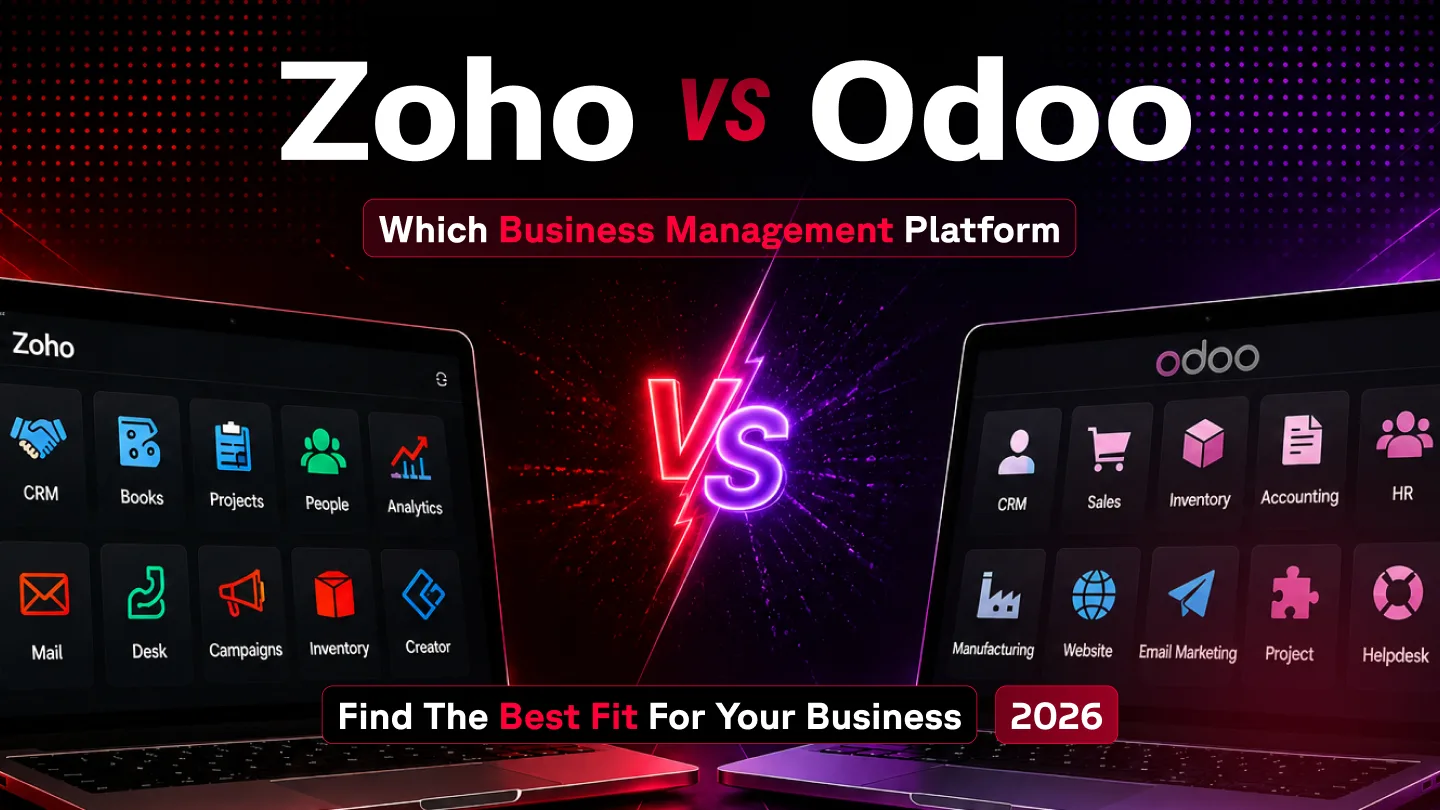
Zoho is a broad suite of easy-to-use cloud apps (best bought as the Zoho One bundle) — fast to adopt, low-maintenance, and ideal for small and mid-sized businesses that want to get running quickly. Odoo is a single, deeply integrated open-source ERP — more customisable and better for complex or manufacturing-heavy operations, but it typically needs more setup or an implementation partner. Choose Zoho for simplicity and speed; choose Odoo for depth and tailored ERP.
“Which business management platform should we use?” is one of the most consequential software decisions a growing company makes. Pick well and your teams share clean data across sales, finance, and operations. Pick badly and you're stuck migrating again in two years. Zoho and Odoo are two of the most popular answers — and they suit genuinely different kinds of businesses. Let's break down how they compare.
What each platform actually is
Zoho is a family of 50-plus cloud applications — CRM, Books (accounting), Desk (support), Inventory, People (HR), Projects, and many more — that you can adopt individually or together. Most businesses buy Zoho One, a bundle that gives you the whole suite for one predictable per-user price. Each app is polished, hosted by Zoho, and works well out of the box with minimal setup.
Odoo takes the opposite approach: one unified platform with modular apps that all share a single database and interface. Sales, inventory, manufacturing, accounting, and website all live in the same system, so data flows seamlessly between them. Odoo is open source, with a free Community edition and a paid Online/Enterprise version — which means it can be customised at the source-code level for exactly how your business runs.
Ease of use & setup
This is where the two diverge most clearly. Zoho is easier to start with. Apps are ready to use, the interfaces are clean, and a small business can be productive in days without technical help. It's designed for teams that want software to just work.
Odoo is more powerful but steeper. Because it models your entire operation in one connected system, getting it configured — especially for manufacturing, multi-warehouse inventory, or bespoke workflows — usually benefits from an implementation partner. The payoff is a system moulded precisely to your processes; the cost is more time and expertise upfront.
Pricing & total cost of ownership
Both look affordable on the surface, but the real number is total cost of ownership, not the sticker price:
- Zoho — Zoho One is a per-user bundle that's excellent value if you use many of its apps. Costs are predictable, hosting is included, and maintenance overhead is low.
- Odoo — the Community edition is free, and Enterprise is priced per user plus per app. Software cost can be low, but implementation, customisation, hosting (for self-managed Community), and ongoing support add up. For complex deployments, services often outweigh licences.
Customisation & flexibility
Zoho offers strong configuration, workflow automation, and low-code building through Zoho Creator and its Deluge scripting language. You can tailor a lot without a developer — but you stay within Zoho's ecosystem and boundaries.
Odoo, being open source, lets developers modify existing modules or build entirely new ones at the code level. If your business has unusual processes that no off-the-shelf tool handles, Odoo's flexibility is hard to beat. That freedom is exactly why it appeals to companies with in-house or partner developers.
Modules & coverage
Both cover the core business functions, with different strengths:
- CRM & sales: Zoho CRM is mature and widely loved; Odoo CRM is solid and tightly linked to the rest of the ERP.
- Accounting: both are capable; local tax and compliance support varies by region, so check yours.
- Inventory & manufacturing: Odoo's MRP and inventory modules are a standout for production and complex logistics.
- Website & e-commerce: Odoo includes a built-in website/e-commerce builder in the same system; Zoho covers commerce across several apps.
- HR, support, projects: both offer strong, well-integrated options.
Zoho vs Odoo at a glance
| Factor | Zoho | Odoo |
|---|---|---|
| Model | Suite of cloud apps (Zoho One) | Unified open-source ERP |
| Ease of setup | Fast, minimal IT needed | Deeper, often needs a partner |
| Customisation | Low-code (Creator, Deluge) | Full source-code level |
| Manufacturing / complex ops | Good for lighter needs | Excellent (MRP, inventory) |
| Hosting | Cloud, managed by Zoho | Cloud or self-hosted |
| Best for | SMBs wanting speed & simplicity | Growing / complex businesses |
So which should you choose?
There's no universal winner — only the right fit for your business:
- Choose Zoho if you want to be up and running fast, have limited IT capacity, and value a polished, low-maintenance suite — especially if you'll use many Zoho One apps.
- Choose Odoo if you have complex or manufacturing-heavy operations, want one deeply unified ERP, or need source-level customisation — and you have (or will hire) technical support to implement it well.
- Still unsure? Map your actual workflows first. The platform that matches your processes with the least friction almost always wins over the one with the longer feature list.
- Zoho = a suite of easy cloud apps; fast to adopt, low-maintenance, great for SMBs.
- Odoo = a unified open-source ERP; deeply customisable, strong for complex & manufacturing operations.
- Compare total cost of ownership over 3–5 years, not just licence price.
- Odoo offers more freedom and depth; Zoho offers faster, safer setup for non-developers.
- Fit to your workflow beats a longer feature list every time.
Picking the platform is step one — setting it up so it actually fits your business is where the value is won or lost. Dezvo helps companies choose, implement, customise, and integrate business platforms — and connect them to modern AI automation, custom web applications, and AI integrations. Tell us about your operations and we'll recommend the right path.