
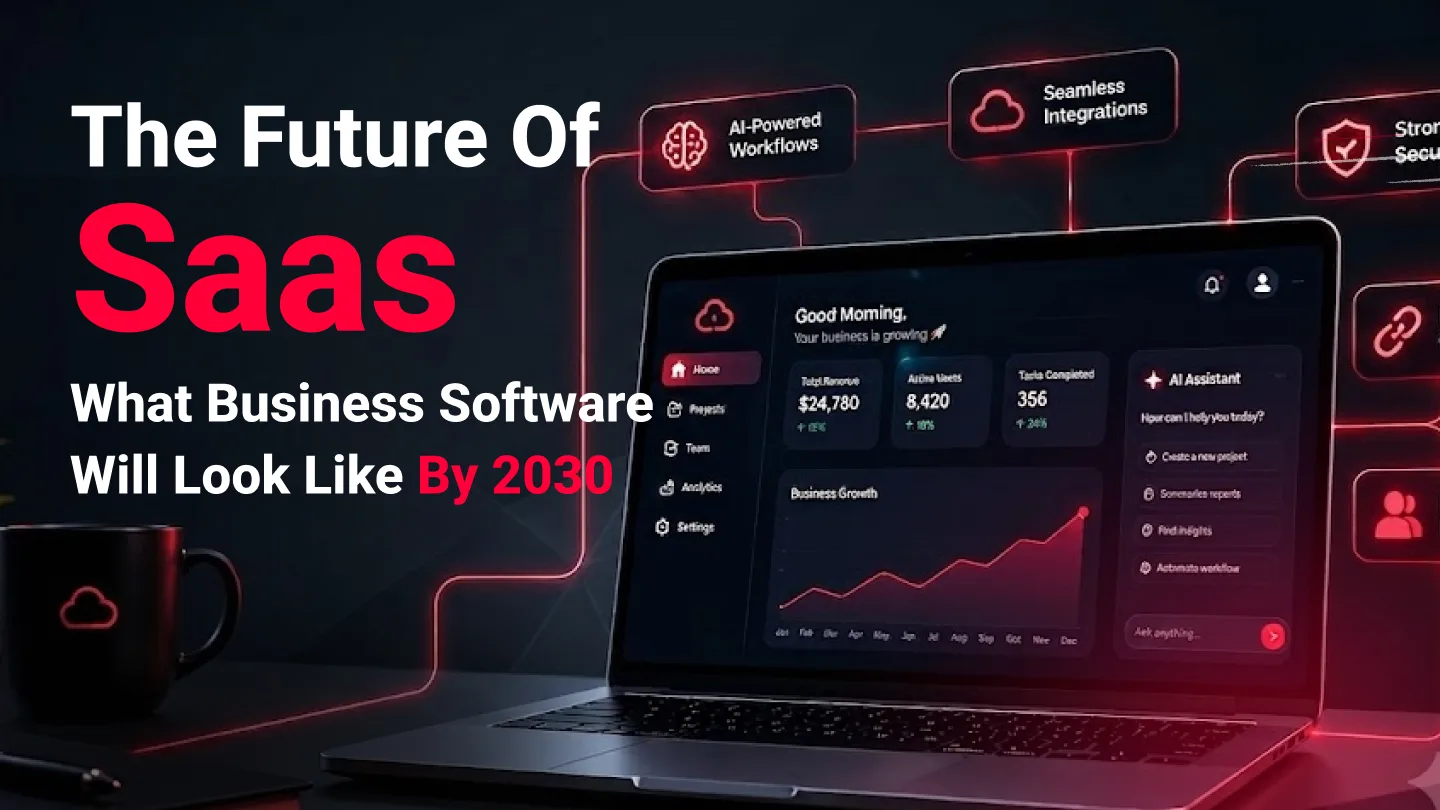
By 2030, SaaS shifts from software you operate to outcomes AI delivers. Expect agentic workflows (agents doing multi-step work inside the product), conversational interfaces alongside dashboards, deep vertical AI built for specific industries, usage- and outcome-based pricing beyond per-seat, and composable stacks where bought SaaS and custom AI apps interoperate through data and APIs. Systems of record stay essential; thin, single-feature tools get absorbed. The businesses that win treat software as something that produces results, not just something people log into.
SaaS has barely changed shape since the mid-2000s. You buy a subscription, you get logins, and your team learns to drive a set of dashboards. Every new tool added more screens to switch between. The model made software cheaper and easier to buy — but the human still did all the actual work, one click at a time, across a dozen tabs.
AI breaks that pattern. When software can reason and act, the question stops being "how many people need a login?" and becomes "what outcome do you want?" That reframing ripples through the whole industry — the interface, the pricing, the competitive map. Here's where business software is heading by 2030.
1. From tools to outcomes
The defining shift: SaaS stops selling access and starts selling results. Today you buy a CRM and your reps do the work of logging calls, chasing follow-ups, and updating stages. By 2030, the software increasingly does that work — and the pitch becomes "leads qualified" or "deals progressed," not "here are your fields to fill in."
This changes what "using software" even feels like. Instead of navigating features, you set goals and review what the software produced. The dashboard becomes a place you check results and handle exceptions, not the place you grind out every task by hand.
2. Agentic workflows built in
Every serious SaaS product will ship with agents inside it. Rather than a chatbot bolted on the side, agents will operate the core features: moving records through a pipeline, reconciling data, drafting and sending communications, triaging tickets, generating reports — multi-step work that used to require a human at the keyboard.
The user's role becomes supervisory: define the goal, set guardrails, approve the consequential decisions, and let the agent handle the rest. Products that make this delegation smooth — with clear permissions, audit trails, and human approval at the right moments — will feel a generation ahead of those that don't.
3. Vertical AI beats generic tools
General-purpose software is being challenged by deep, industry-specific tools. A generic project tracker is useful; software built specifically for a dental practice, a law firm, a construction company, or a ceramic exporter — that understands that industry's data, rules, and workflows — is far more valuable when AI is doing the work.
By 2030, expect a wave of vertical SaaS where the AI is trained on and tuned for one industry's realities. The moat isn't the interface; it's the specialised knowledge and data. Broad horizontal platforms will still exist, but the fastest-growing, stickiest products will often be narrow and deep.
4. Pricing moves beyond per-seat
Per-seat pricing assumes humans are the ones doing the work. When AI does it, that assumption collapses — you might run a workflow thousands of times with a handful of human supervisors. So pricing shifts toward usage and outcomes: a base subscription plus charges tied to tasks completed, workflows run, or results delivered.
This aligns cost with value, but it also raises the bar. Buyers will demand proof that the software actually produced the outcome, and vendors will need to show ROI clearly. The comfortable "everyone gets a seat" revenue model gives way to something more accountable.
5. Composable, connected stacks
The all-in-one suite loses ground to composable stacks. Because AI makes custom software dramatically cheaper to build, more businesses will assemble a mix: bought SaaS for commodity needs (accounting, email, core systems of record) plus custom AI apps and agents for the workflows that actually differentiate them — all wired together through APIs and shared data.
Interoperability becomes a headline feature. Software that locks data away and refuses to play with agents and other tools becomes a liability. The value increasingly lives in how well everything connects, not in any single walled-garden app.
SaaS then vs. SaaS by 2030
| Dimension | SaaS today | SaaS by 2030 |
|---|---|---|
| Core value | Access to tools | Outcomes delivered |
| Who does the work | Your team, click by click | Agents, with human oversight |
| Interface | Dashboards & forms | Goals, chat + dashboards |
| Pricing | Per seat / subscription | Usage & outcome-based |
| Best products | Broad, horizontal | Deep, vertical AI |
| Architecture | All-in-one suites | Composable, connected |
How to prepare now
You don't need to predict every trend — just move in the direction the whole market is heading:
- Get your data clean and connected. Outcome-driven, agentic software is only as good as the data it can trust and reach.
- Map your workflows. Know which processes are commodity (buy SaaS) and which are differentiators (worth custom, AI-powered tools).
- Prefer software that's open and agent-ready. APIs, permissions, and audit logs matter more than a flashy feature list.
- Judge tools by results, not seats. Start asking vendors to prove the outcome, and pilot usage-based options where they fit.
- SaaS shifts from software you operate to outcomes AI delivers.
- Agents will do multi-step work inside products, with humans supervising.
- Deep vertical AI beats generic horizontal tools for real work.
- Pricing moves from per-seat to usage- and outcome-based models.
- Composable, connected stacks beat all-in-one suites — interoperability is the new moat.
Dezvo builds the software businesses will run on next — custom AI applications, agentic workflows, and connected systems designed around outcomes, not just screens. Explore our web application development, AI integration, and website development services, or compare platforms in our Zoho vs Odoo guide. Tell us what outcome you want your software to deliver and we'll help you build it.